What Is AI Automation? A Business Owner's Guide
8 min read · By Hamza Amir · Updated August 10, 2026
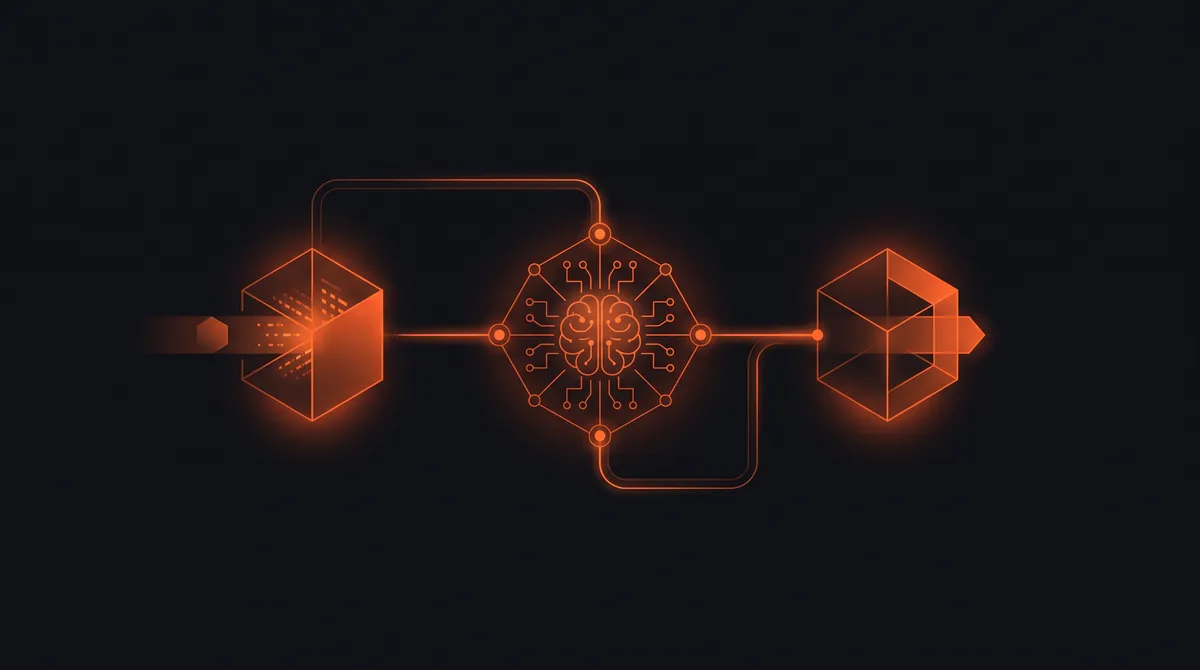
AI automation is the use of artificial intelligence to run multi-step business work from start to finish, not just triggering a task when a rule fires, but reading information, making a decision, and taking the next action. It combines classic automation (moving data between systems, triggering steps) with AI models that can classify, draft, and handle exceptions, so entire workflows run with a human involved only where judgment is genuinely needed.
That distinction matters. A traditional automation follows a fixed script and breaks the moment the input looks slightly different. AI automation reads the messy, real-world input (an email, a document, a support ticket, a lead form), understands it, and decides what to do. It's the difference between a conveyor belt and a capable assistant who knows the process.
The upside is well documented. McKinsey estimates that current generative AI and other technologies can automate work that absorbs 60 to 70 percent of the time employees spend today, which is why the question for most businesses is no longer whether to automate but what to automate first.
This guide explains what AI automation is, how it differs from the terms it gets confused with, where it actually saves money, and what a real project looks like, so you can tell the substance from the hype.
Key takeaways
- AI automation = software that reads, decides, and acts across a multi-step workflow, not a single rule-based trigger.
- It differs from traditional automation (rigid rules) by handling unstructured input and exceptions.
- It pays back fastest on high-volume, repetitive work: CRM updates, lead routing, support triage, document processing, reporting.
- Most pilots are fixed-scope and go live in 4 to 8 weeks. You don't need to automate everything at once.
- Start with the single workflow that costs you the most time or the most dropped balls.
What is AI automation, exactly?
AI automation is a system that connects the tools you already use and runs a process end to end using AI to make the judgment calls a fixed script can't. A request or piece of data enters, the system classifies it, pulls the context it needs, decides the next step, performs it, and escalates to a person only when something falls outside its confidence or authority.
The practical test: if a task is repetitive, follows a general pattern but has variation, and currently eats a person's time every week, it's a candidate for AI automation. Think inbox triage, updating a CRM after every call, qualifying inbound leads, reconciling invoices, or turning a data room into a first-draft summary.
AI automation vs traditional automation and RPA
Traditional automation (including most workflow automation and classic RPA) follows explicit rules: *if this, then that*. It's fast and reliable for structured, predictable inputs, but it breaks when a form field moves, a document is formatted differently, or an email doesn't match the template it expects. (We break this down fully in AI vs automation.)
AI automation adds a model that can interpret. It reads an unstructured email and extracts the order details; it looks at a support message and decides the category and urgency; it reviews a contract and flags the unusual clause. Rules still run the deterministic parts; AI handles the parts that used to require a human to *understand* something first.
In practice the two work together: the AI interprets and decides, and rule-based automation carries out the mechanical steps once the decision is made. Combining rules, AI, and workflow across a whole process is what we call intelligent automation.
See what this would save in your business.
Get a free automation teardown: the top 3 workflows we'd automate for you, and what each would save. 20 minutes, no commitment.
AI automation vs AI agents, what's the difference?
An AI agent is a specific, more autonomous form of AI automation. Where a typical automation runs a defined path, an agent is given a goal, a set of tools, and permission to decide the sequence of actions itself, reading from your systems, taking multiple steps, and looping until the task is done. Every AI agent is AI automation; not every AI automation is a full agent.
For most businesses the right answer is a mix: scoped automations for well-defined processes, and AI agents for the workflows that genuinely need multi-step reasoning. If you want the deeper version, see our guide on how to build AI agents.
Where AI automation actually pays off
The wins are concentrated in high-volume, repetitive, multi-step work, the tasks that scale with your growth and quietly consume headcount. For a fuller catalog, see these AI automation examples across departments, or the playbook for using AI for operational efficiency. Common starting points:
- Sales & CRM: capturing, enriching, scoring, and routing leads, and keeping the CRM current without reps living in data entry.
- Support: classifying tickets, answering routine ones from your own knowledge, and routing the rest with context (support automation).
- Operations: order processing, quoting, scheduling, approvals, and document flows connected into one system.
- Marketing & content: research, briefs, and repurposing one idea into many channels.
- Finance & back office: invoice matching, reconciliations, and report generation, much of it AI document automation reading and posting the numbers for you.
What does an AI automation project look like?
A serious engagement is not a magic box, it's a scoped build. It usually runs in four stages: map the workflow as it really happens; connect permissioned access to the systems involved (CRM, inbox, help desk, ERP); build the decision logic and a human-in-the-loop escalation path; and run it, refining as edge cases surface.
Most first projects are structured as a fixed-scope, fixed-price pilot that ships in 4 to 8 weeks. You prove the return on one workflow before expanding, which is exactly how you de-risk the investment. You can see this play out in our case studies, where one team eliminated 80+ hours of weekly manual CRM work and another deflected 58% of support tickets before a human saw them.
How much does AI automation cost, and how do you start?
Cost depends on scope and integration depth, but most pilots land in a defined band with a fixed price and timeline, no open-ended retainer to begin. For the full breakdown, see what AI automation costs. The bigger question is *where* to start, and the answer is always the same: the single workflow that costs you the most time or loses you the most money today.
The fastest way to find that is to look at where your team spends its week and where things fall through the cracks, which is exactly what AI consulting is for. If you'd like a second opinion, book a scoping call, we'll tell you what we'd automate first and what it would take.
No. A chatbot replies to messages and stops. AI automation runs an entire multi-step workflow, reading data, deciding, and acting inside your systems (updating a CRM, routing a ticket, processing a document), and only involves a human for exceptions.
Want this built on your systems?
Get a free automation teardown. We'll map the top 3 workflows we'd automate in your business and what they'd save, in 20 minutes, no commitment.
Response time
≤ 4 business hours
Coverage
USA · UK · EU
Team
10 engineers · 1 PM