AI vs Automation: What's the Difference and When You Need Each
7 min read · By Hamza Amir · Updated August 3, 2026
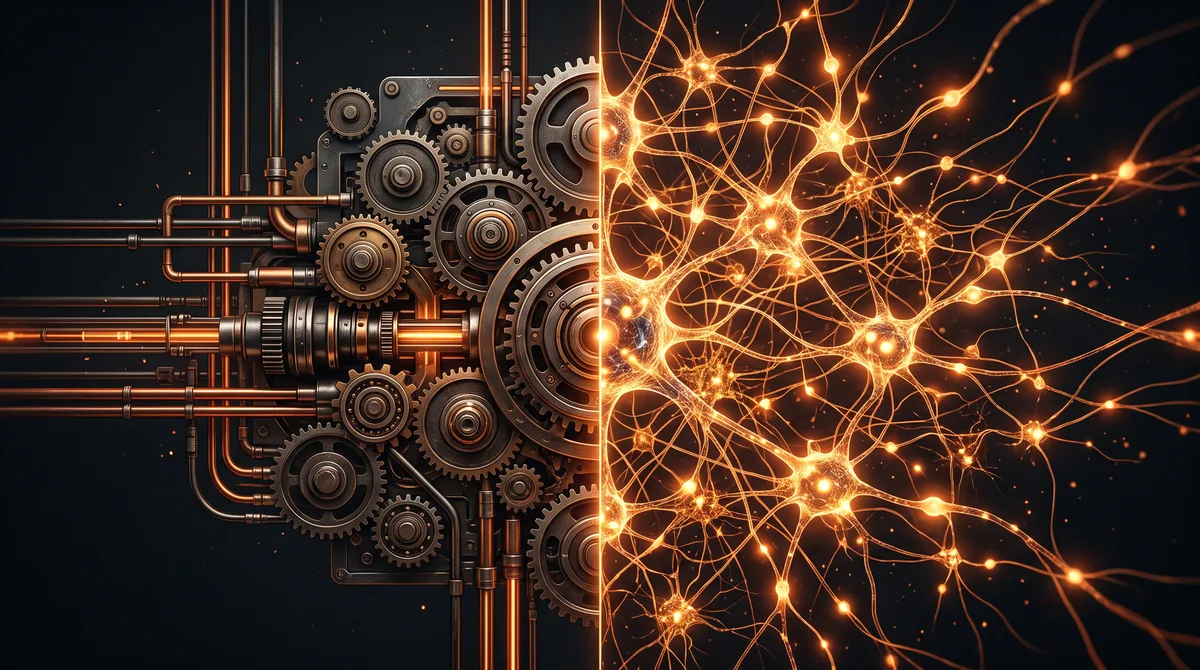
Automation follows rules you define. AI makes the judgment calls you cannot easily write as rules. That one distinction is the whole difference between AI and automation, and getting it right is what decides whether a project ships value or stalls.
The two get sold as the same thing, which causes expensive mistakes: teams buy AI for work a simple rule could handle, or force rigid automation onto a process that actually needs interpretation. Knowing which is which saves both money and months.
The stakes are real, and adoption is racing ahead. Stanford's 2025 AI Index reports that the share of organizations using generative AI in at least one business function jumped from 33 percent to 71 percent in a single year. But the value depends on using the right tool for each task, which starts with knowing which is which.
This guide explains what separates AI from automation, where each fits, and why the best systems use both together.
Key takeaways
- Automation executes fixed, rule-based steps. AI interprets unstructured input and makes decisions.
- Automation suits predictable, structured tasks. AI suits work where inputs vary and judgment is needed.
- They are complementary, not competing: AI decides, automation executes.
- Most real systems are hybrids, an AI layer sitting on top of rule-based automation.
What is automation?
Automation is software that runs a fixed sequence of steps whenever a trigger fires: if this happens, do that. It is deterministic, fast, and reliable for structured, predictable work, moving data between systems, sending a templated email, updating a record, generating a scheduled report.
Classic tools like Zapier flows and rule-based RPA live here. Their strength is consistency. Their limit is rigidity: the moment a form field moves, a document is formatted differently, or an input does not match the template, the automation breaks or does the wrong thing, because it cannot interpret anything it was not explicitly told about.
What is AI, in this context?
AI, in the automation sense, is a model that can interpret messy, real-world input and make a judgment: it reads an unstructured email and extracts the order, looks at a support message and decides the category and urgency, or reviews a contract and flags the unusual clause.
Where automation follows rules, AI recognizes patterns learned from data. It is probabilistic rather than deterministic, which is exactly why it can handle variation and exceptions that no rule set anticipates, and also why it needs guardrails and a human in the loop where the stakes are high.
See what this would save in your business.
Get a free automation teardown: the top 3 workflows we'd automate for you, and what each would save. 20 minutes, no commitment.
AI vs automation: the key differences
The cleanest way to tell them apart is by the kind of work each is built for:
| Dimension | Traditional automation | AI |
|---|---|---|
| Input | Structured, predictable | Unstructured, variable |
| Logic | Fixed rules you write | Patterns learned from data |
| Handles exceptions | No, it breaks | Yes, it interprets |
| Output | Deterministic | Probabilistic |
| Best for | Repetitive, well-defined steps | Judgment and interpretation |
Neither is better in the abstract. A rule engine is the right answer for a predictable step, and AI is the right answer for a decision that used to need a person. The mistake is using one where the other belongs.
When to use automation vs AI
A quick decision test for any step in a process:
- Use automation when the input is structured and the rule is stable: moving data, triggering steps, scheduled reports, templated notifications.
- Use AI when the input is unstructured or varies, and a person currently has to read and decide: classifying messages, extracting data from documents, drafting a first response, spotting anomalies.
- Use both when a process has a judgment step buried in mechanical ones, which describes most real workflows.
Why the best systems combine both
In practice the two are not rivals, they are layers. The AI interprets the messy part and decides what should happen; rule-based automation carries out the deterministic steps once the decision is made. That combination is what people usually mean by AI automation: a system that reads, decides, and acts end to end.
This is how a single workflow runs itself, an AI layer reading the incoming work and a workflow automation layer executing it, with a person involved only on the exceptions. Get the division of labor right and you get reliability and flexibility at the same time.
No. Automation runs fixed, rule-based steps. AI interprets unstructured input and makes decisions. Automation is deterministic; AI is probabilistic. They are complementary, and most real systems use both.
Want this built on your systems?
Get a free automation teardown. We'll map the top 3 workflows we'd automate in your business and what they'd save, in 20 minutes, no commitment.
Response time
≤ 4 business hours
Coverage
USA · UK · EU
Team
10 engineers · 1 PM