AI Integration Services: Connecting AI to the Tools You Already Use
7 min read · By Hamza Amir · Updated August 9, 2026
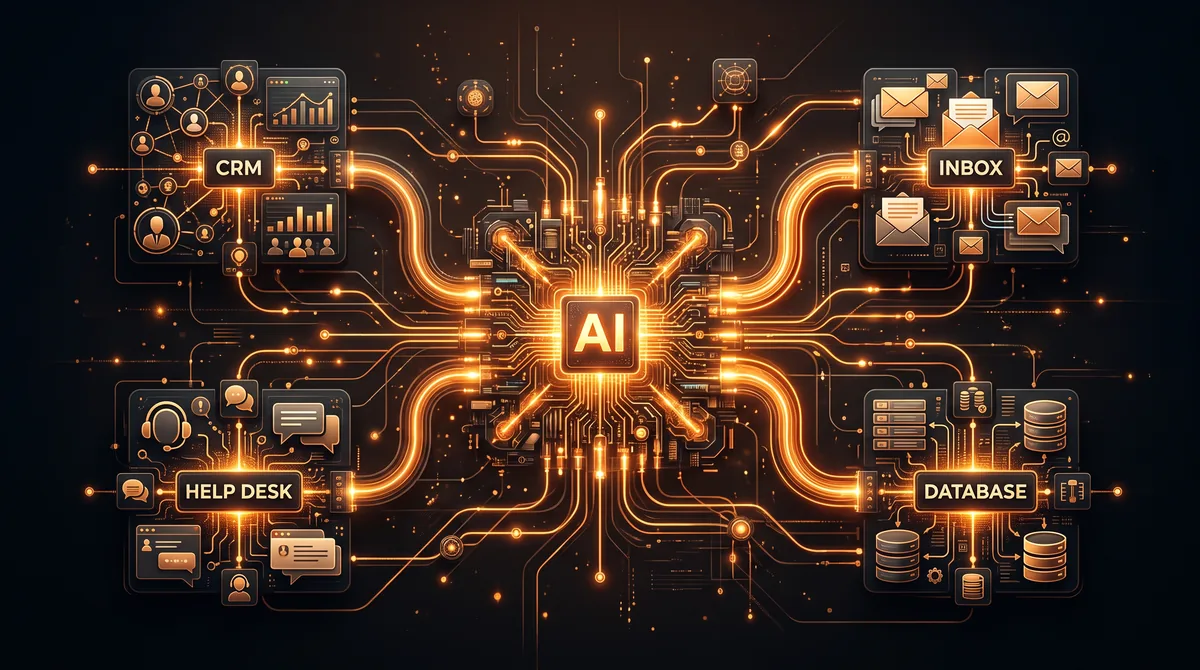
AI integration services connect AI to the systems you already run, your CRM, inbox, help desk, ERP, and databases, so it can read from them, act in them, and fit your real workflow instead of living in a separate chat window. Integration is the unglamorous part where most AI projects quietly succeed or fail.
It is where the value shows up. In one engagement, integrating AI into a team's CRM workflow gave a Series B SaaS team 80 hours a week back to selling, the win came from the integration, not the model.
This guide covers what AI integration services do, why integration decides whether AI pays off, what it costs, and how to scope it safely.
Key takeaways
- AI integration wires models into your existing tools so they can read and act, not just chat.
- Most AI projects fail at integration, not at the model.
- The work is permissioned access, data flow, guardrails, and a human-in-the-loop path.
- Scope one integration, prove it, then expand across the stack.
What AI integration services do
Integration is the plumbing that turns a clever model into a working system. It means giving AI permissioned access to your tools, moving data between them reliably, and building the logic that lets an AI agent or automation act, updating a CRM record, drafting a reply in your help desk, pulling a figure from your ERP, with guardrails and a human-in-the-loop path where it matters.
Without integration, AI is a demo in a separate window. With it, AI runs inside the workflow your team already lives in.
Why integration is where AI projects live or die
The model is rarely the hard part anymore. The hard part is connecting it to messy, real-world systems safely: authentication, rate limits, data formats, edge cases, and permissions. This is why impressive pilots so often stall, they were never integrated into how work actually happens.
Good AI integration services treat this as the main event, not an afterthought.
See what this would save in your business.
Get a free automation teardown: the top 3 workflows we'd automate for you, and what each would save. 20 minutes, no commitment.
What it costs and how to scope it
Integration cost scales with how many systems are involved and how clean their access is. The reliable pattern is a fixed-scope pilot integrating one workflow end to end, proving it works, then expanding. See AI automation pricing for the models and what drives cost.
The fastest way to scope it
A free automation teardown maps the top 3 workflows worth integrating AI into, and flags where the integration is straightforward versus where it needs care, in about 20 minutes, no commitment.
They connect AI to the systems you already run, CRM, inbox, help desk, ERP, databases, so it can read from them and act in them within your real workflow, rather than sitting in a separate chat window. The work is permissioned access, data flow, logic, and guardrails.
Want this built on your systems?
Get a free automation teardown. We'll map the top 3 workflows we'd automate in your business and what they'd save, in 20 minutes, no commitment.
Response time
≤ 4 business hours
Coverage
USA · UK · EU
Team
10 engineers · 1 PM