How AI Consulting Works: The Process, Step by Step
8 min read · By Hamza Amir · Updated August 10, 2026
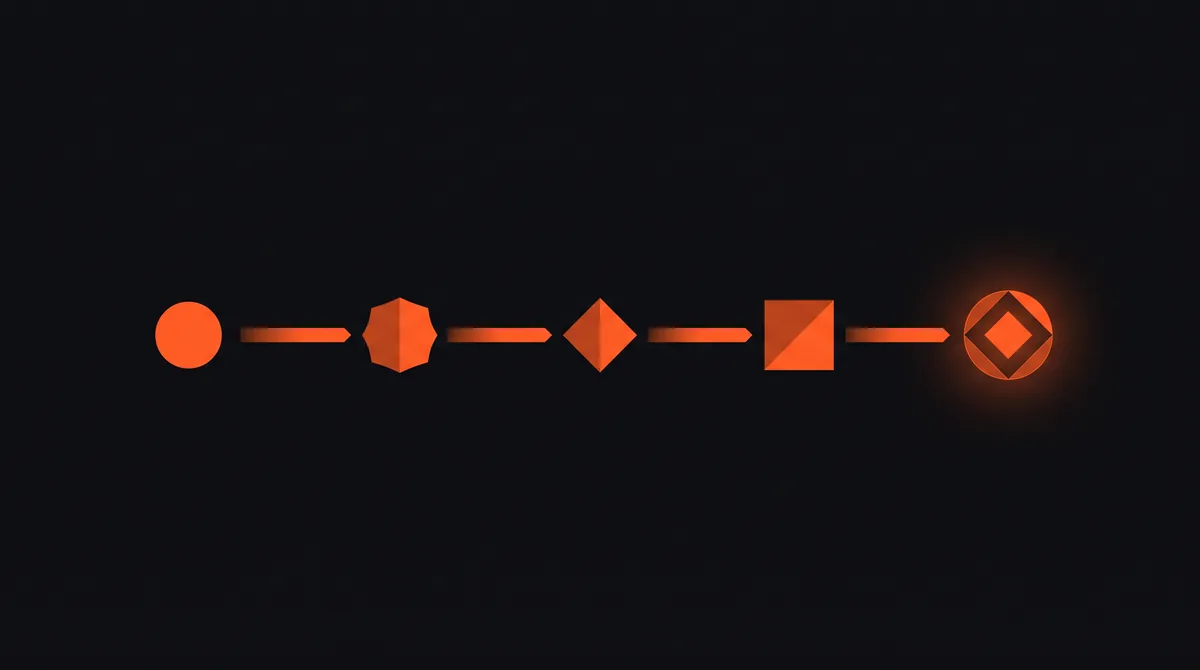
The AI consulting process is the structured path a good firm follows to turn a vague sense that AI could help into a working system that delivers a measurable outcome: discover the highest-value opportunities, sequence them, build, deploy, and measure. Done well, it is concrete and costed from the first week, not a slide deck about the future.
It matters because adoption has outrun results. McKinsey reports that 78 percent of organizations now use AI in at least one function, yet most have not turned it into meaningful bottom-line impact. A disciplined process is what closes that gap.
This guide walks through each stage of the process, the methodology that underpins it, the engagement models, and how to tell an engagement is working. For the broader definition, see what AI consulting is.
Key takeaways
- A good AI consulting process runs discovery, opportunity assessment, roadmap, build, deployment, and measurement.
- It starts from your workflows and costs, not a technology wishlist.
- The best firms both advise and build, so you buy an outcome, not a report.
- Every stage produces something concrete: a costed plan, a shipped pilot, a measured result.
- You know it is working when a real workflow costs less time or money than before.
Stage 1: Discovery, mapping your workflows and costs
The process starts with your operation, not with AI. A good consultant maps how work actually happens, every hand-off, spreadsheet, and manual step, and attaches numbers: how often each process runs and how many hours it consumes. The goal is to find where time and money are leaking, because that is where AI pays back fastest.
The first question a strong consultant asks is where you lose the most time, not which model you want to use.
Stage 2: Opportunity assessment and prioritization
Next, each opportunity is scored on value and feasibility: how much it would save, how clean the data access is, how many systems it touches, and how tolerant of error it is. That produces a shortlist ranked by payback, so the sequence is deliberate rather than driven by whatever sounds exciting.
This is where a good process kills bad ideas early, including ideas that sound impressive but would not pay back.
See what this would save in your business.
Get a free automation teardown: the top 3 workflows we'd automate for you, and what each would save. 20 minutes, no commitment.
Stage 3: The roadmap, sequencing early wins
The shortlist becomes a roadmap that sequences the work so early wins fund later ones. A strong roadmap is costed and time-boxed: each item has a fixed scope, a price, and a timeline, reviewed with you before any build begins.
The point of sequencing is momentum. Prove the return on one workflow, reinvest the reclaimed time, and expand from a position of evidence instead of hope.
Stage 4: Build, deployment, and handover
The best firms do not stop at advice; they build. A pilot is developed against your real systems with a human-in-the-loop escalation path, tested on real historical cases, then deployed, starting supervised and widening as it earns trust. At handover you get the documentation, source code, and credentials, so you own what was built (AI agents, workflow automation, and RAG systems are the usual building blocks).
The gap between a slide deck and a working system is where most AI initiatives die. A process that includes the build is what carries you across it.
Stage 5: Measurement and iteration
Finally, the result is measured against the baseline set in discovery: hours reclaimed, cycle time, error rate, and cost per transaction. Those numbers decide what to automate next. Measurement is not a formality; it is how the roadmap stays honest and how you know the spend is working.
AI consulting engagement models
The process is delivered through one of a few models:
- Strategy only: assessment and roadmap, you execute. Cheapest, but leaves the hardest part to you.
- Fixed-scope build: a defined pilot at a fixed price and timeline, the lowest-risk way to start.
- Build and run: systems built and operated on an ongoing basis, iterated as your process evolves.
For most businesses the firm worth hiring both scopes and ships, so you are buying an outcome. If that is what you want, book a scoping call.
It is the structured path from problem to working system: discovery of your workflows and costs, opportunity assessment and prioritization, a costed roadmap, build and deployment of a pilot, and measurement against a baseline. Each stage produces something concrete rather than just advice.
Want this built on your systems?
Get a free automation teardown. We'll map the top 3 workflows we'd automate in your business and what they'd save, in 20 minutes, no commitment.
Response time
≤ 4 business hours
Coverage
USA · UK · EU
Team
10 engineers · 1 PM