AI Agents for Marketing: What They Do and Where to Start
7 min read · By Hamza Amir · Updated August 5, 2026
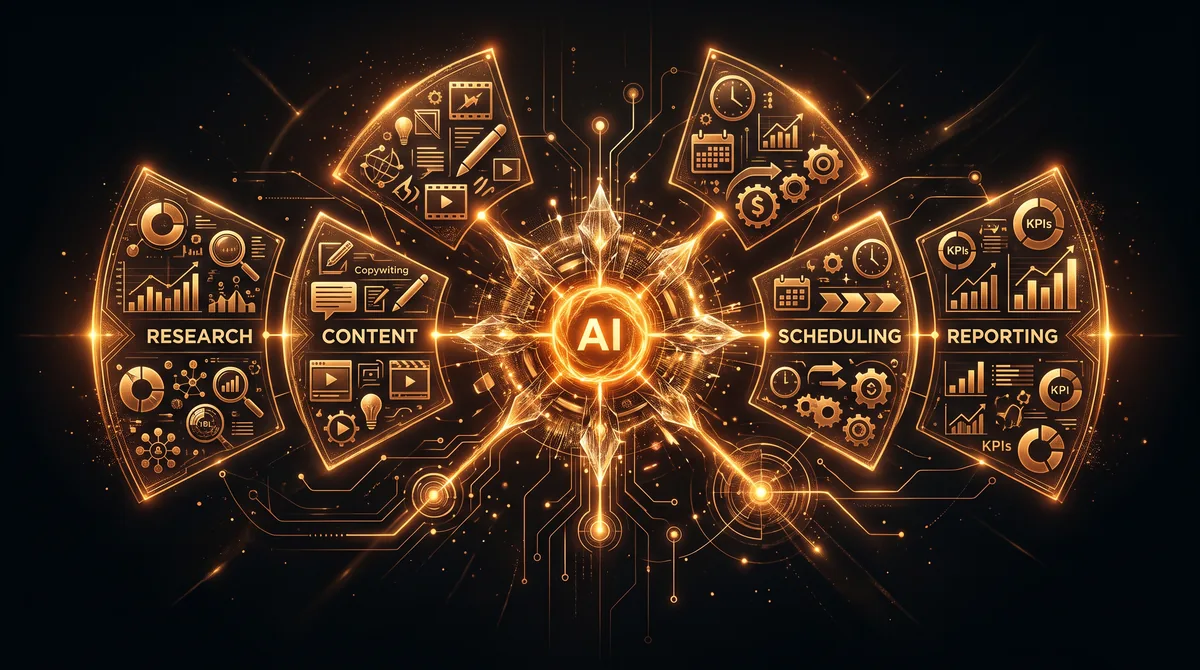
AI agents for marketing are software agents that take a goal, use your tools, and carry out marketing work across several steps: researching topics, drafting and repurposing content, scheduling posts, enriching leads, and pulling performance reports, with a person setting direction and approving what matters.
The output gains are real. In one engagement, a B2B services firm went from 2 to 12 posts a month with the same headcount by handing the repetitive production work to an automated system. Agents extend that from content into campaigns, data, and reporting.
This guide covers what AI agents for marketing actually do, the use cases worth starting with, and how to deploy one without losing brand control.
Key takeaways
- Marketing agents automate the repetitive engine: research, drafting, repurposing, scheduling, and reporting.
- They free marketers for strategy and creative, they do not replace them.
- The best first use cases are content production and lead enrichment.
- Brand voice, fact-checking, and final approval stay human.
What do AI agents for marketing do?
A marketing agent handles the repetitive engine that sits behind good marketing, the work that scales with output and quietly consumes a team's week:
- Research: gathering angles, keywords, and the questions your audience actually asks.
- Content drafting and repurposing: first drafts and reshaping one idea into platform-native posts.
- Scheduling and distribution: publishing on a cadence across channels.
- Lead enrichment and scoring: adding context to inbound leads and prioritizing them.
- Reporting: pulling performance data into a regular, readable summary.
Highest-value use cases to start with
Start where the volume and repetition are highest and the risk is lowest. The two clearest wins are content production, turning a content calendar into drafts and platform-native posts, and lead handling, enriching and routing inbound so nothing goes cold. Both compound quickly and are easy to measure.
Reporting is a strong third: a weekly performance summary that used to eat an afternoon can be assembled automatically and reviewed in minutes.
See what this would save in your business.
Get a free automation teardown: the top 3 workflows we'd automate for you, and what each would save. 20 minutes, no commitment.
Where humans stay in charge
Agents own execution, not judgment. A person still sets the strategy, owns the brand voice, checks facts, and approves anything that goes out. AI that only recombines generic web text produces forgettable marketing, so the original insight and creative direction have to stay human. This is the same balance covered in AI content automation and generative AI for business.
How to deploy a marketing agent safely
Scope one workflow first, content production is the usual starting point, and keep a human approval step before anything publishes. Ground the agent in your brand guidelines and real assets rather than generic text, set clear rules for what it can and cannot send, and measure output and quality together.
Prove the return on one workflow, then expand into the next. That is how marketing automation built on AI agents scales without turning your brand into generic filler.
They are software agents that carry out marketing work across multiple steps, research, content drafting and repurposing, scheduling, lead enrichment, and reporting, with a person setting direction and approving what matters.
Want this built on your systems?
Get a free automation teardown. We'll map the top 3 workflows we'd automate in your business and what they'd save, in 20 minutes, no commitment.
Response time
≤ 4 business hours
Coverage
USA · UK · EU
Team
10 engineers · 1 PM