AI in Private Equity: Where It Actually Adds Value
8 min read · By Hamza Amir · Updated August 7, 2026
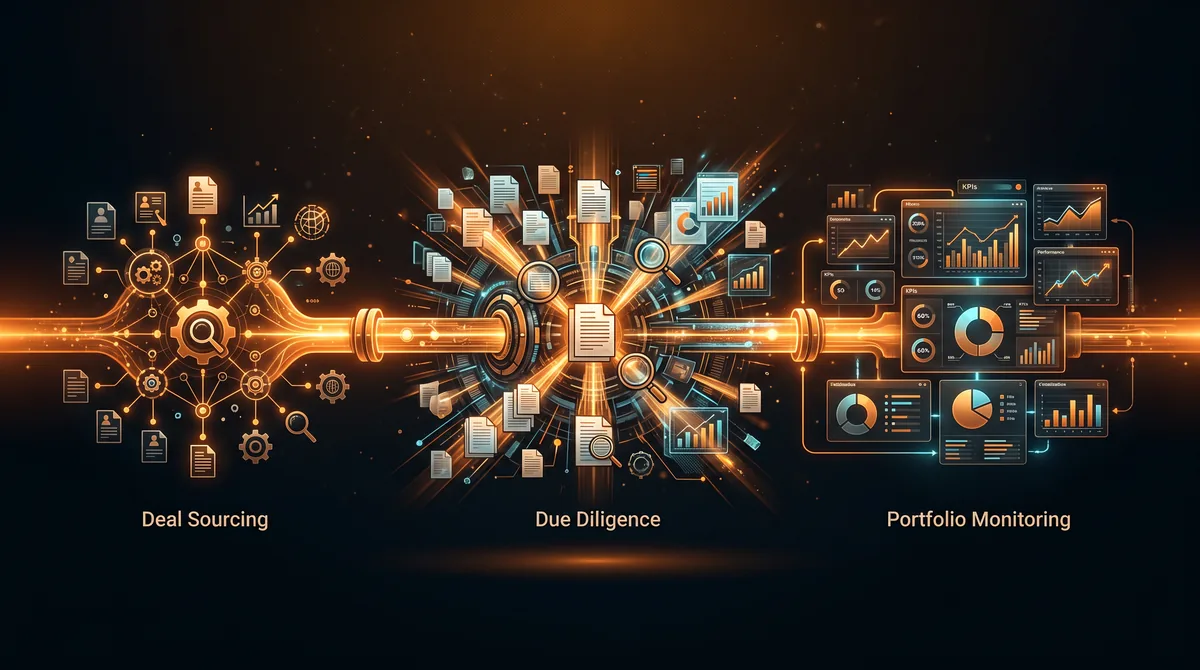
AI in private equity is moving from conference talk to daily workflow. The funds pulling ahead are not using it to pick winners by magic; they are using it to compress the manual, analyst-heavy work that sits between a thesis and a decision: sourcing targets, reading data rooms, monitoring portfolios, and reporting to LPs.
The shift is real. Stanford's 2025 AI Index reports the share of organizations using generative AI in at least one function jumped from 33 percent to 71 percent in a single year, and financial sponsors are no exception.
This guide covers where AI genuinely adds value across the deal lifecycle, the workflows that pay back first, and how to adopt it without betting the fund on a black box.
Key takeaways
- AI does not replace investment judgment; it compresses the manual work around it.
- The highest-value workflows are deal sourcing, due diligence, portfolio monitoring, and LP operations.
- Sourcing and diligence reclaim analyst hours; monitoring catches drift early; LP ops removes reporting grind.
- Adopt it as scoped systems on your own data, with humans owning every decision.
Where AI adds value across the deal lifecycle
AI pays off in private equity wherever the work is high-volume, information-heavy, and currently done by hand. That maps cleanly onto four stages of the fund's operating cycle:
- Deal sourcing: monitoring target universes and scoring against the thesis.
- Due diligence: ingesting data rooms, extracting terms, and flagging risk.
- Portfolio monitoring: continuous health scoring with early drift alerts.
- LP operations: reporting and capital-call workflows with a full audit trail.
None of these replace the investor. Each removes the grunt work that slows a small team down, so partners spend their time on judgment, not data gathering.
Deal sourcing: from manual screening to continuous coverage
Sourcing is mostly manual screening: analysts working through lists, news, and databases to find companies that fit the thesis. AI turns that into continuous coverage, monitoring the target universe, scoring each company against the fund's criteria, enriching the promising ones, and writing qualified targets straight into the CRM.
The result is broader coverage with fewer missed companies, and analysts reviewing a ranked shortlist instead of building it. This is exactly what our AI deal sourcing system does for funds.
See what this would save in your business.
Get a free automation teardown: the top 3 workflows we'd automate for you, and what each would save. 20 minutes, no commitment.
Diligence, early signals, and portfolio monitoring
Diligence is where AI saves the most hours. A diligence engine ingests a data room, extracts key terms, flags risks, and drafts a first-pass investment memo, turning days of reading into a reviewed draft. Reading unstructured documents at speed is the same capability behind AI document automation, applied to deal materials.
Beyond a single deal, AI surfaces early signals months before a process reaches market, and once a company is in the portfolio, continuous monitoring scores its health and raises drift alerts before problems reach the board. That is the difference between finding out at the quarterly review and finding out in week two.
LP operations and how to adopt AI safely
On the back office side, LP operations automation handles reporting and capital calls with an audit trail, removing a reporting grind that scales badly with fund size.
The safe way to adopt all of this is not a general chatbot. It is scoped systems running on your own permissioned data, grounded so they cite their sources, with a human owning every investment decision and a full audit trail behind every output. See the full picture of our private equity deal operations work, or the broader case for AI business process automation.
Mainly to compress manual work across the deal lifecycle: sourcing and scoring targets, ingesting data rooms and drafting diligence memos, monitoring portfolio company health, and automating LP reporting and capital calls. It supports decisions rather than making them.
Want this built on your systems?
Get a free automation teardown. We'll map the top 3 workflows we'd automate in your business and what they'd save, in 20 minutes, no commitment.
Response time
≤ 4 business hours
Coverage
USA · UK · EU
Team
10 engineers · 1 PM